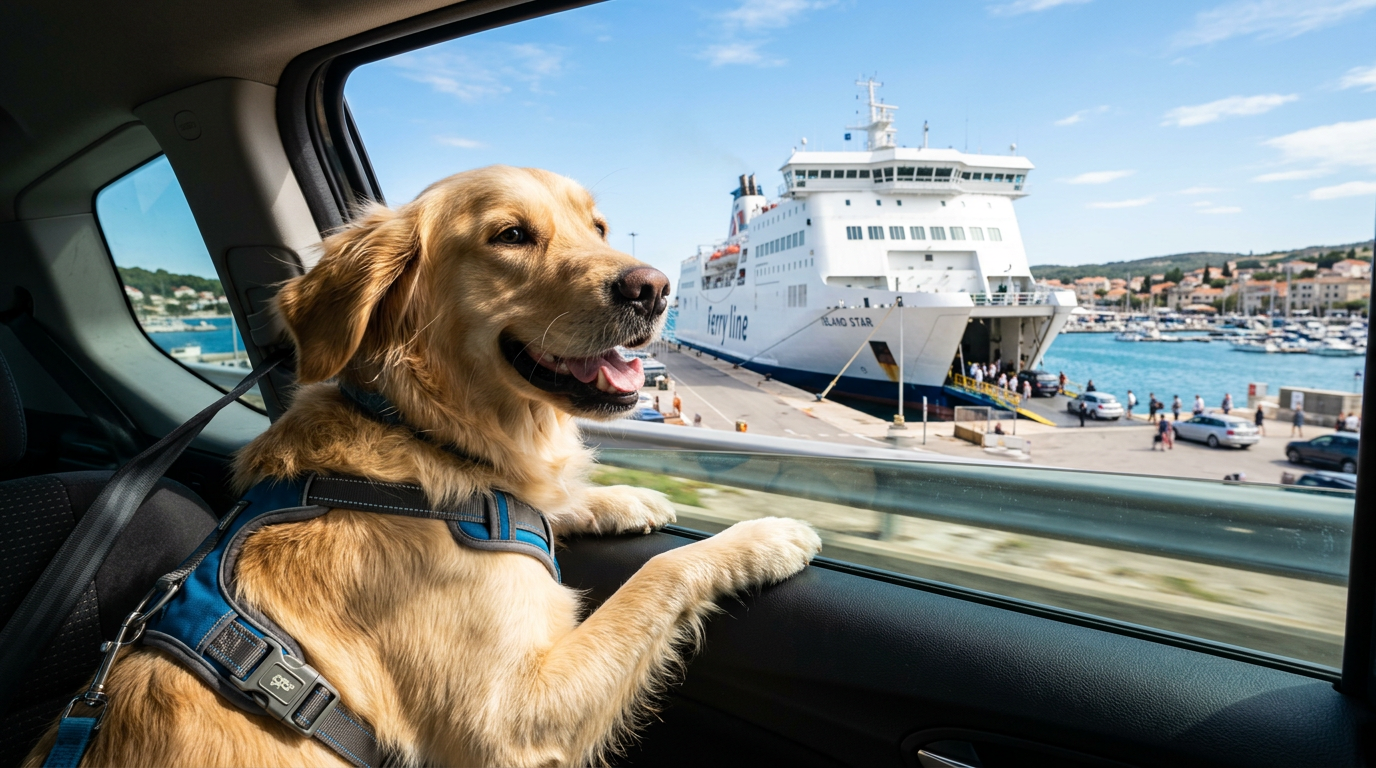
Taking a cross channel ferry with pets from the UK to Europe is a straightforward and popular option for holidays. As long as you have the correct documentation and book with a pet-friendly operator, you and your furry companion can enjoy a smooth and comfortable journey together.
This guide explains the essential paperwork, compares the options onboard, and provides practical advice for a stress-free trip. Travelling with your four-legged friend is much easier than many people think, making a European road trip a fantastic holiday choice.
Key takeaways
- You need a valid Animal Health Certificate (AHC) or pet passport for your pet to travel from the UK to the EU.
- Most ferry operators require pets to remain in your vehicle or in a pre-booked kennel or pet-friendly cabin.
- Book your pet’s travel in advance as spaces, especially pet-friendly cabins, are limited and sell out quickly.
- The cost of taking a pet varies by ferry company and is typically charged per pet for each leg of the journey.
- Prepare for the trip by familiarising your pet with your car and their travel carrier to minimise stress.
What Paperwork Do I Need for Ferry Travel with My Pet?
To take your pet on a ferry to the EU, you need a valid Animal Health Certificate (AHC) or a pet passport issued in an EU country, a microchip, and a current rabies vaccination. You must get this documentation in order well before you travel, as an AHC can only be issued by an official veterinarian within 10 days of your departure date.
Here are the key requirements for taking your pet dog, cat, or ferret to the EU:
- Microchip: Your pet must be microchipped before, or at the same time as, their rabies vaccination. The microchip number must be correctly recorded on all their documentation.
- Rabies Vaccination: Your pet must be at least 12 weeks old before they can be vaccinated. You must then wait 21 days after the vaccination (or the last of the primary course of vaccinations) before you can travel.
- Animal Health Certificate (AHC): If you are travelling from Great Britain (England, Scotland, Wales), you will need an AHC for travel to the EU. This document is valid for one trip only, including onward travel within the EU for up to four months and for your return journey to Great Britain.
- Tapeworm Treatment: For dogs travelling to Finland, Republic of Ireland, Northern Ireland, Norway or Malta, they must have a tapeworm treatment administered by a vet between one and five days before arriving in that country.
Always check the latest government guidance and the specific requirements of the country you are travelling to before booking your a cross channel ferry with pets.
Which Ferry Companies Are Pet-Friendly?
Most major cross-channel ferry operators, including DFDS, P&O Ferries, and Brittany Ferries, allow you to travel with pets, though their specific rules and facilities vary by route and ship. It is essential to declare your pet at the time of booking to secure their spot and ensure the vessel is equipped for pet travel.
On the popular Dover to Calais ferry route, both P&O Ferries and DFDS Seaways accommodate pets. Irish Ferries also operates on this route and has provisions for pets. On other routes, such as those to Spain or the Netherlands, you will find options like Brittany Ferries and Stena Line, which often provide onboard kennels or pet-friendly cabins for the longer journeys.
What Are the Onboard Options for My Pet?
During the crossing, pets typically either remain in your vehicle, stay in pre-booked onboard kennels, or join you in a designated pet-friendly cabin, depending on the ferry operator and vessel. The option you choose will significantly impact your pet’s comfort and your own experience during the journey.
For short crossings like Dover to Calais, most operators require pets to remain in the vehicle. On longer sailings, dedicated pet facilities are more common. It’s crucial to understand the differences before you book your trip.
| Onboard Option | Description | Best For | Availability |
|---|---|---|---|
| Remain in Vehicle | Your pet stays in your car on the vehicle deck. Access is usually prohibited during the crossing. | Short crossings (e.g., under 2 hours), calm pets used to your car. | Most short-haul UK-France routes. |
| Onboard Kennels | Cages of various sizes located in a dedicated, ventilated area. You may be able to visit at set times. | Longer crossings, larger dogs, or owners who prefer not to use a cabin. | Many routes (e.g., to Spain, Netherlands). |
| Pet-Friendly Cabin | A standard passenger cabin where your pet can stay with you. Usually includes a laminate floor. | Anxious pets, owners wanting constant contact, overnight sailings. | Limited on specific long-haul routes. |
Regardless of the option, you are responsible for your pet. Ensure they have water, and if leaving them in your car, make sure it is well-ventilated by leaving windows slightly open. Never leave a pet in a hot car.
How Much Does a Cross Channel Ferry with Pets Cost?
The cost to bring a pet on a ferry is an additional fee charged per pet, each way, with prices varying depending on the ferry company, route, and the type of onboard accommodation you choose. The fee is separate from your main vehicle and passenger ticket price. Booking a pet-friendly cabin will incur a higher cost than leaving your pet in your vehicle or using an onboard kennel.
Generally, expect a charge per pet for each leg of the journey. For example, a return trip from Dover to Dunkirk would involve two separate pet charges. Prices are usually fixed but can vary, so it is always best to confirm the exact cost during the booking process on the operator’s website.
How to Prepare Your Pet for a Ferry Crossing
Prepare your pet for a ferry trip by ensuring they are comfortable with car travel, avoiding large meals just before sailing, and packing familiar items like a blanket or toy to help them settle. A well-prepared pet is a calm pet, which makes the journey more pleasant for everyone.
Before you go:
- Acclimatise to the car: Take your pet on several short drives in the days leading up to your trip, making the car a familiar and positive place.
- Vet check-up: Ensure all vaccinations are up to date and discuss any concerns, such as motion sickness, with your vet. They may be able to prescribe medication.
- Pack a pet bag: Include their lead, harness, food, water bowl, fresh water, poo bags, a favourite toy, and a familiar blanket.
On the day:
- Exercise: Give your dog a good walk and a chance to go to the toilet before you arrive at the port.
- Feeding: Give them a light meal a few hours before you travel, but not immediately before boarding, to help prevent sickness.
- Stay calm: Pets are very perceptive and will pick up on your stress. A calm and confident owner helps to reassure an anxious animal.
What to Expect at the Ferry Port
At the port, you will go through a specific pet check-in process where an official will scan your pet’s microchip and verify their Animal Health Certificate (AHC) or pet passport before you can proceed to board. This is a dedicated step separate from passport control for human passengers.
Upon arrival at the ferry terminal, look for signs for the “Pet Reception” or “Pet Check-in” area. Here, you will present your pet and their documents. The official will use a handheld scanner to read the microchip and ensure it matches the paperwork. Once cleared, you will be given a sticker for your car windscreen, which identifies it as carrying a pet. This sticker signals to the loading crew to, where possible, park you in an area with better ventilation on the car deck.
Ferry vs. Eurotunnel for Pet Travel: Which Is Better?
The best choice between the ferry and Eurotunnel depends on your pet’s temperament; the Eurotunnel is quicker and allows you to stay with your pet, while ferries offer more facilities and fresh air for longer journeys. For a detailed comparison, see our guide on the Dover to Calais ferry vs. Eurotunnel.
Eurotunnel Le Shuttle offers a crossing time of just 35 minutes, during which you and your pet remain together in your vehicle. This is often the preferred choice for anxious pets who would be distressed by being left alone. The process is quick and efficient.
A cross channel ferry with pets, on the other hand, gives you the chance to leave your car and enjoy the ship’s amenities. While rules for pets are stricter onboard, the longer crossing time can be a welcome break on a long drive. If you book a dog-friendly cabin, your pet can relax with you in private, making it an excellent option for overnight or extended sailings.
Related reading
- Best Dover to Dunkirk Ferry Deals: A Guide
- Dover to Dunkirk Ferry With Car: The Ultimate Guide
- How Long is Dover to Dunkirk Ferry? A Complete Journey Guide
Frequently Asked Questions
Can my dog come out of the car on the ferry?
Generally, no. On most short cross-channel routes, pets must remain in the vehicle for the duration of the crossing. On longer routes, if you haven’t booked a pet-friendly cabin, they may only be allowed out in designated pet exercise areas on deck.
Do I need a passport for my dog to go to France?
If you are travelling from Great Britain, you will need an Animal Health Certificate (AHC) to take your dog to France. Pet passports issued in Great Britain are no longer valid for travel to the EU. EU-issued pet passports are still accepted.
Is it better to take a dog on a ferry or Eurotunnel?
It depends on your dog. The Eurotunnel is faster (35 mins) and you stay with your pet in the car, which is ideal for anxious dogs. Ferries are longer but some offer pet-friendly cabins or kennels, which can be better for extended journeys.
What happens if my pet’s microchip cannot be read?
If your pet’s microchip cannot be read at check-in, you will not be allowed to travel. It is crucial to have the chip checked by your vet before your trip to ensure it is working correctly and is easy to locate.
Can I take more than one pet on the ferry?
Yes, you can usually travel with multiple pets. Most ferry companies allow you to book several pets, though there might be a limit. Each pet will require their own valid documentation and reservation, and a fee is typically charged per animal.
Do foot passengers take pets on a cross channel ferry?
Policies for foot passengers with pets vary significantly by operator and route. Some companies do not permit pets with foot passengers at all, while others do but require the pet to be in a secure, airline-approved carrier for the entire journey.
Taking a cross channel ferry with pets from the UK to Europe is a straightforward and popular option for holidays. As long as you have the correct documentation and book with a pet-friendly operator, you and your furry companion can enjoy a smooth and comfortable journey together.
This guide explains the essential paperwork, compares the options onboard, and provides practical advice for a stress-free trip. Travelling with your four-legged friend is much easier than many people think, making a European road trip a fantastic holiday choice.
Key takeaways
- You need a valid Animal Health Certificate (AHC) or pet passport for your pet to travel from the UK to the EU.
- Most ferry operators require pets to remain in your vehicle or in a pre-booked kennel or pet-friendly cabin.
- Book your pet’s travel in advance as spaces, especially pet-friendly cabins, are limited and sell out quickly.
- The cost of taking a pet varies by ferry company and is typically charged per pet for each leg of the journey.
- Prepare for the trip by familiarising your pet with your car and their travel carrier to minimise stress.
What Paperwork Do I Need for Ferry Travel with My Pet?
To take your pet on a ferry to the EU, you need a valid Animal Health Certificate (AHC) or a pet passport issued in an EU country, a microchip, and a current rabies vaccination. You must get this documentation in order well before you travel, as an AHC can only be issued by an official veterinarian within 10 days of your departure date.
Here are the key requirements for taking your pet dog, cat, or ferret to the EU:
- Microchip: Your pet must be microchipped before, or at the same time as, their rabies vaccination. The microchip number must be correctly recorded on all their documentation.
- Rabies Vaccination: Your pet must be at least 12 weeks old before they can be vaccinated. You must then wait 21 days after the vaccination (or the last of the primary course of vaccinations) before you can travel.
- Animal Health Certificate (AHC): If you are travelling from Great Britain (England, Scotland, Wales), you will need an AHC for travel to the EU. This document is valid for one trip only, including onward travel within the EU for up to four months and for your return journey to Great Britain.
- Tapeworm Treatment: For dogs travelling to Finland, Republic of Ireland, Northern Ireland, Norway or Malta, they must have a tapeworm treatment administered by a vet between one and five days before arriving in that country.
Always check the latest government guidance and the specific requirements of the country you are travelling to before booking your a cross channel ferry with pets.
Which Ferry Companies Are Pet-Friendly?
Most major cross-channel ferry operators, including DFDS, P&O Ferries, and Brittany Ferries, allow you to travel with pets, though their specific rules and facilities vary by route and ship. It is essential to declare your pet at the time of booking to secure their spot and ensure the vessel is equipped for pet travel.
On the popular Dover to Calais ferry route, both P&O Ferries and DFDS Seaways accommodate pets. Irish Ferries also operates on this route and has provisions for pets. On other routes, such as those to Spain or the Netherlands, you will find options like Brittany Ferries and Stena Line, which often provide onboard kennels or pet-friendly cabins for the longer journeys.
What Are the Onboard Options for My Pet?
During the crossing, pets typically either remain in your vehicle, stay in pre-booked onboard kennels, or join you in a designated pet-friendly cabin, depending on the ferry operator and vessel. The option you choose will significantly impact your pet’s comfort and your own experience during the journey.
For short crossings like Dover to Calais, most operators require pets to remain in the vehicle. On longer sailings, dedicated pet facilities are more common. It’s crucial to understand the differences before you book your trip.
| Onboard Option | Description | Best For | Availability |
|---|---|---|---|
| Remain in Vehicle | Your pet stays in your car on the vehicle deck. Access is usually prohibited during the crossing. | Short crossings (e.g., under 2 hours), calm pets used to your car. | Most short-haul UK-France routes. |
| Onboard Kennels | Cages of various sizes located in a dedicated, ventilated area. You may be able to visit at set times. | Longer crossings, larger dogs, or owners who prefer not to use a cabin. | Many routes (e.g., to Spain, Netherlands). |
| Pet-Friendly Cabin | A standard passenger cabin where your pet can stay with you. Usually includes a laminate floor. | Anxious pets, owners wanting constant contact, overnight sailings. | Limited on specific long-haul routes. |
Regardless of the option, you are responsible for your pet. Ensure they have water, and if leaving them in your car, make sure it is well-ventilated by leaving windows slightly open. Never leave a pet in a hot car.
How Much Does a Cross Channel Ferry with Pets Cost?
The cost to bring a pet on a ferry is an additional fee charged per pet, each way, with prices varying depending on the ferry company, route, and the type of onboard accommodation you choose. The fee is separate from your main vehicle and passenger ticket price. Booking a pet-friendly cabin will incur a higher cost than leaving your pet in your vehicle or using an onboard kennel.
Generally, expect a charge per pet for each leg of the journey. For example, a return trip from Dover to Dunkirk would involve two separate pet charges. Prices are usually fixed but can vary, so it is always best to confirm the exact cost during the booking process on the operator’s website.
How to Prepare Your Pet for a Ferry Crossing
Prepare your pet for a ferry trip by ensuring they are comfortable with car travel, avoiding large meals just before sailing, and packing familiar items like a blanket or toy to help them settle. A well-prepared pet is a calm pet, which makes the journey more pleasant for everyone.
Before you go:
- Acclimatise to the car: Take your pet on several short drives in the days leading up to your trip, making the car a familiar and positive place.
- Vet check-up: Ensure all vaccinations are up to date and discuss any concerns, such as motion sickness, with your vet. They may be able to prescribe medication.
- Pack a pet bag: Include their lead, harness, food, water bowl, fresh water, poo bags, a favourite toy, and a familiar blanket.
On the day:
- Exercise: Give your dog a good walk and a chance to go to the toilet before you arrive at the port.
- Feeding: Give them a light meal a few hours before you travel, but not immediately before boarding, to help prevent sickness.
- Stay calm: Pets are very perceptive and will pick up on your stress. A calm and confident owner helps to reassure an anxious animal.
What to Expect at the Ferry Port
At the port, you will go through a specific pet check-in process where an official will scan your pet’s microchip and verify their Animal Health Certificate (AHC) or pet passport before you can proceed to board. This is a dedicated step separate from passport control for human passengers.
Upon arrival at the ferry terminal, look for signs for the “Pet Reception” or “Pet Check-in” area. Here, you will present your pet and their documents. The official will use a handheld scanner to read the microchip and ensure it matches the paperwork. Once cleared, you will be given a sticker for your car windscreen, which identifies it as carrying a pet. This sticker signals to the loading crew to, where possible, park you in an area with better ventilation on the car deck.
Ferry vs. Eurotunnel for Pet Travel: Which Is Better?
The best choice between the ferry and Eurotunnel depends on your pet’s temperament; the Eurotunnel is quicker and allows you to stay with your pet, while ferries offer more facilities and fresh air for longer journeys. For a detailed comparison, see our guide on the Dover to Calais ferry vs. Eurotunnel.
Eurotunnel Le Shuttle offers a crossing time of just 35 minutes, during which you and your pet remain together in your vehicle. This is often the preferred choice for anxious pets who would be distressed by being left alone. The process is quick and efficient.
A cross channel ferry with pets, on the other hand, gives you the chance to leave your car and enjoy the ship’s amenities. While rules for pets are stricter onboard, the longer crossing time can be a welcome break on a long drive. If you book a dog-friendly cabin, your pet can relax with you in private, making it an excellent option for overnight or extended sailings.
Related reading
- Best Dover to Dunkirk Ferry Deals: A Guide
- Dover to Dunkirk Ferry With Car: The Ultimate Guide
- How Long is Dover to Dunkirk Ferry? A Complete Journey Guide
Frequently Asked Questions
Can my dog come out of the car on the ferry?
Generally, no. On most short cross-channel routes, pets must remain in the vehicle for the duration of the crossing. On longer routes, if you haven’t booked a pet-friendly cabin, they may only be allowed out in designated pet exercise areas on deck.
Do I need a passport for my dog to go to France?
If you are travelling from Great Britain, you will need an Animal Health Certificate (AHC) to take your dog to France. Pet passports issued in Great Britain are no longer valid for travel to the EU. EU-issued pet passports are still accepted.
Is it better to take a dog on a ferry or Eurotunnel?
It depends on your dog. The Eurotunnel is faster (35 mins) and you stay with your pet in the car, which is ideal for anxious dogs. Ferries are longer but some offer pet-friendly cabins or kennels, which can be better for extended journeys.
What happens if my pet’s microchip cannot be read?
If your pet’s microchip cannot be read at check-in, you will not be allowed to travel. It is crucial to have the chip checked by your vet before your trip to ensure it is working correctly and is easy to locate.
Can I take more than one pet on the ferry?
Yes, you can usually travel with multiple pets. Most ferry companies allow you to book several pets, though there might be a limit. Each pet will require their own valid documentation and reservation, and a fee is typically charged per animal.
Do foot passengers take pets on a cross channel ferry?
Policies for foot passengers with pets vary significantly by operator and route. Some companies do not permit pets with foot passengers at all, while others do but require the pet to be in a secure, airline-approved carrier for the entire journey.