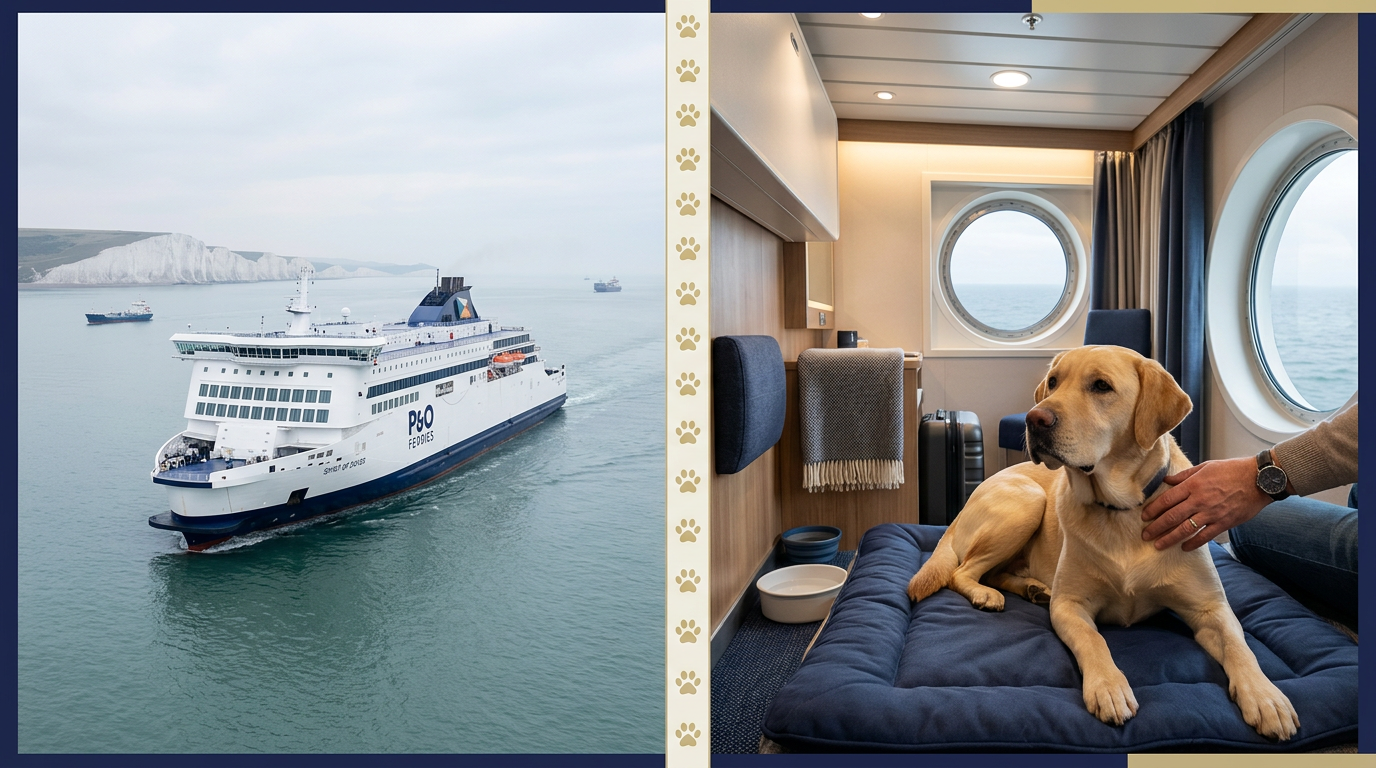
Key stat: Only two of the five major UK ferry operators — Brittany Ferries and DFDS — offer bookable pet-friendly cabins where dogs can stay with their owners overnight on cross-Channel and long-haul routes.
UK Ferry Pet Travel Rules 2026: What the Operators Won’t Tell You Until You’ve Booked
Audit of operator booking flows, terms pages and pet travel policy documents across DFDS, P&O Ferries, Brittany Ferries, Stena Line and CalMac reveals a sharp gap between headline promises and what passengers actually receive when travelling with dogs in 2026.
The industry line is consistent: “pets welcome aboard.” The granular reality, when you move beyond the landing page and into the actual booking conditions, is a patchwork of kennel-only policies, restricted deck access, species carve-outs and surcharges that vary not just by operator but by route, vessel class and sailing time.
The cabin question is where most dog owners get caught out. Operators broadly advertise pet travel but bury the distinction between a dog-friendly cabin — where your pet stays in the room with you — and a ship’s kennel, where the dog is housed in a separate onboard facility and you visit during set hours. These are fundamentally different experiences, and the price gap between routes that offer each option can run to £80 or more per crossing.
What the Operator-by-Operator Audit Found
Brittany Ferries is the clear leader for dog cabin access on longer routes. Its Commodore Club and Club Voyage cabins on ships including Pont-Aven and Armorique on the Plymouth–Roscoff and Portsmouth–Santander routes carry designated pet-friendly cabins where dogs travel in the room. The operator caps the number of pet cabins per sailing — typically four to six per ship — meaning early booking is not optional, it is essential. Surcharges in 2025–2026 run from approximately £30 for short crossings to £55–£75 for overnight Atlantic routes. Brittany Ferries also operates kennels on vessels where pet cabins are unavailable, and its documentation explicitly states that pets must remain in the cabin or kennel — not in standard passenger areas — unless passing through to designated outdoor decks.
DFDS offers pet-friendly cabins on its Dover–Calais and Newcastle–Amsterdam routes. The Dover–Calais service, given its two-hour crossing time, means the “cabin” is essentially a holding option for passengers who want the car deck alternative — dogs may remain in the vehicle on short crossings if the owner elects this. On the Newcastle–Amsterdam overnight route, DFDS provides proper pet cabins at a supplement of around £20–£30. Dogs are not permitted in restaurants, bars or the majority of passenger lounges. Outdoor deck access for pet exercise is available during sailings, but owners must keep dogs on leads at all times and clean up is strictly enforced.
P&O Ferries operates a kennel-only policy across its Dover–Calais route as of 2026. Dogs travel in onboard kennels and owners visit during designated times — typically twice per crossing. There are no dog-friendly passenger cabins on P&O’s cross-Channel fleet. For budget travellers on the short hop, this is manageable; for overnight crossings, it is a significant welfare and comfort difference that the booking flow does not foreground prominently. P&O’s pet fee sits at approximately £25–£30 per crossing.
Stena Line, operating Irish Sea routes including Fishguard–Rosslare, Holyhead–Dublin and Cairnryan–Belfast, follows a broadly kennel-based model. However, Stena does permit dogs to remain in vehicles on the car deck for some short crossings, subject to safety and ventilation rules — in practice, this is only viable in cooler months and the operator advises against it in summer. Pet-friendly cabins are not a standard Stena feature across its current UK/Ireland fleet.
CalMac (Caledonian MacBrayne), operating Scottish island ferry routes, takes a different approach entirely suited to its shorter crossings. Dogs are generally permitted in outdoor deck areas and, on longer CalMac sailings such as Oban–Castlebay (Barra) or Ullapool–Stornoway, in dedicated dog-friendly lounges. The pet surcharge structure is lower than cross-Channel operators — several routes carry no surcharge — but cabin access for dogs is not offered.
Documentation and Booking: Where Gaps Appear
Across all five operators, the booking path for pet travel requires separate pet registration at the time of booking or shortly after — adding a dog post-booking is possible on most platforms but generates friction and, in the case of Brittany Ferries’ pet cabin allocation, may result in no availability.
UK pet passport or Animal Health Certificate (AHC) requirements apply for travel to France, Spain, Netherlands and Ireland. The AHC must be issued by an Official Veterinarian no more than ten days before travel and must confirm microchipping, up-to-date rabies vaccination, and — for return to Great Britain — tapeworm treatment administered one to five days before re-entry. This veterinary administration cost, typically £30–£60 per trip, is invisible in operator pricing but forms a real part of the total cost of ferry pet travel.
What This Means
For dog owners planning 2026 crossings, the single most important booking decision is route selection before operator selection. Brittany Ferries’ longer Atlantic routes are the only realistic option for passengers who require the dog to stay in the cabin overnight. For short Channel crossings, P&O’s kennel model is workable but requires comfort with separation; DFDS on the same route offers a marginally more flexible vehicle-or-cabin choice.
The secondary decision is timing. Pet cabin allocations are small and fill early — March bookings for summer sailings on Brittany Ferries’ Plymouth–Roscoff route are not unusual. Operators have not significantly expanded pet cabin capacity in recent years despite increased demand for pet-inclusive travel post-pandemic.
The industry’s “pets welcome” messaging is accurate in the narrow sense that all five operators accept dogs. It is incomplete in the sense that only two currently offer the cabin-with-dog arrangement that most pet owners, when they read the small print, discover they actually wanted.
| Metric | Brittany Ferries | DFDS | P&O Ferries | Stena Line | CalMac |
|---|---|---|---|---|---|
| Dog cabin (in-room) | Yes — selected routes | Yes — Newcastle–Amsterdam | No | No | No |
| Kennel option | Yes | Yes | Yes | Yes | No (deck/lounge access) |
| Dog in vehicle option | Short crossings only | Dover–Calais short | Not standard | Some routes | Some short crossings |
| Typical pet surcharge | £30–£75 | £20–£30 | £25–£30 | £20–£35 | £0–£15 |
| AHC/pet passport required | Yes (France/Spain routes) | Yes (Netherlands routes) | Yes (France routes) | Yes (Ireland routes) | No (domestic UK) |
| Max dogs per cabin | 1–2 (cabin-dependent) | 1–2 | N/A | N/A | N/A |
| Advance booking required for pet space | Yes — essential | Recommended | Yes | Yes | Less critical |
Frequently Asked Questions
Can my dog stay in the cabin with me on a Channel ferry to France in 2026?
P&O Ferries does not offer dog-friendly cabins on Dover–Calais; dogs travel in onboard kennels. DFDS allows dogs in vehicles on the short crossing or in pet cabins on the Newcastle–Amsterdam overnight route. For a cabin-with-dog experience to France, Brittany Ferries on Plymouth–Roscoff or Portsmouth–Caen is the appropriate operator, though pet cabin numbers are limited and book out quickly.
Do I need an Animal Health Certificate for my dog to travel on a UK ferry to Europe in 2026?
Yes. An Animal Health Certificate issued by an Official Veterinarian within ten days of travel is required for dogs entering France, Spain, the Netherlands and Ireland from Great Britain. It must confirm microchipping and current rabies vaccination. For return to Great Britain, tapeworm treatment administered one to five days before boarding is also required. Costs typically run £30–£60 per trip at a registered vet.
How many pet-friendly cabins does Brittany Ferries allocate per sailing?
Typically four to six pet-friendly cabins per vessel, depending on the ship class. Pont-Aven and Armorique carry designated pet cabins on Atlantic and Channel routes, but availability is strictly limited. Brittany Ferries recommends booking pet cabins at the earliest opportunity — for peak summer sailings, cabins can fill several months in advance.
Can dogs travel on CalMac ferry routes in Scotland without a pet surcharge?
On many CalMac routes, particularly shorter island hops, no pet surcharge applies. Dogs are generally allowed in outdoor deck areas and, on longer sailings, in specific dog-friendly indoor spaces. CalMac does not offer dog-friendly passenger cabins, but the network’s shorter crossing times make deck and lounge access a practical alternative for most journeys.