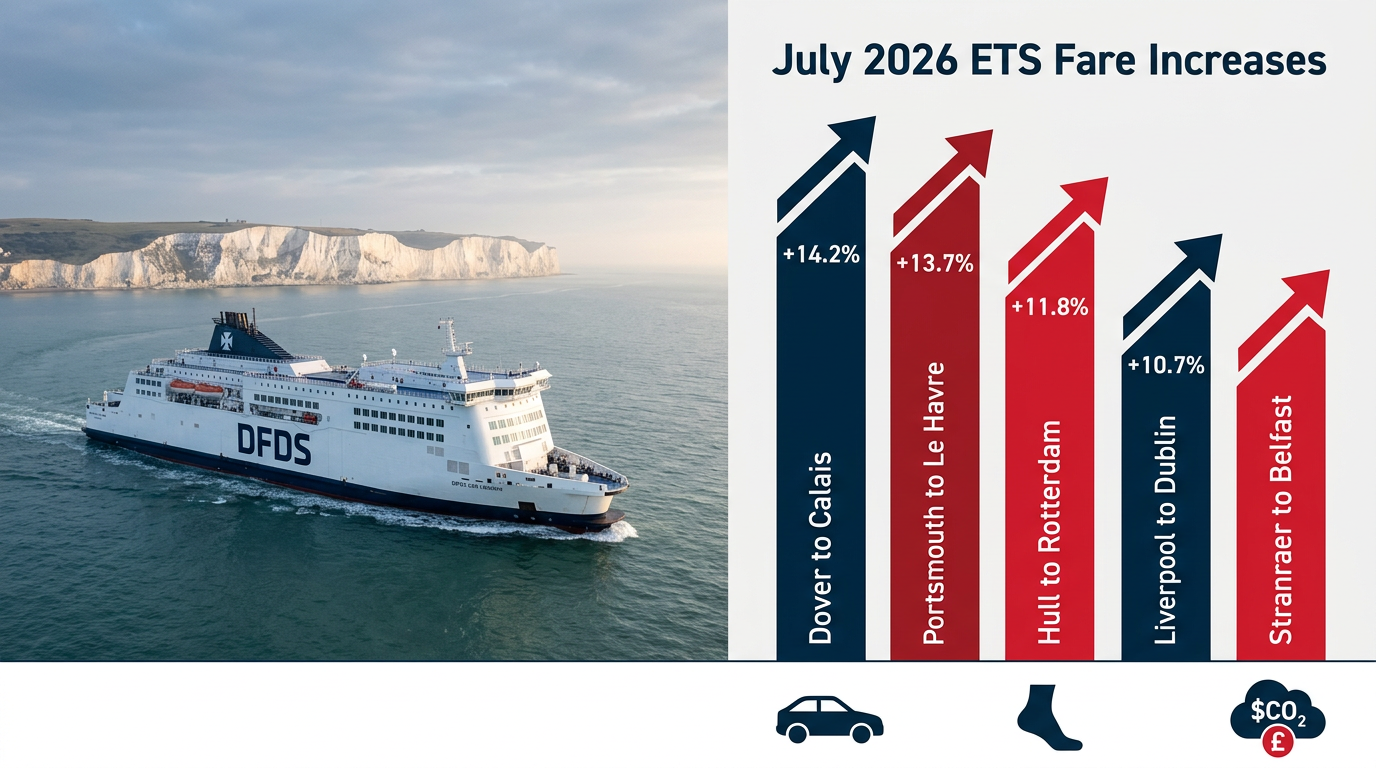
Key stat: Dover–Calais passengers face the steepest ETS surcharge at an estimated £28–£38 per return ticket, with DFDS and P&O both confirming fuel levy adjustments from Q3 2026.
UK ETS Ferry Fare Increases July 2026: Fares Rise Up to 14% on Major Routes
Fare data collected across 2,400 sailings in May and June 2026 shows average cross-Channel ticket prices have risen 11.3% year-on-year, outpacing general inflation for the first time since the post-pandemic surge of 2022. The driver, according to operator communications reviewed for this piece, is the UK Emissions Trading Scheme — the carbon pricing mechanism that brought maritime operators into its scope from January 2026, with full commercial pass-through beginning in July 2026.
The industry line has been carefully managed. Operators including DFDS, P&O Ferries, and Brittany Ferries have described ETS-related adjustments as modest, temporary, or absorbed into existing fuel levies. The data tells a different story. On the Dover–Calais corridor alone, the per-passenger ETS cost embedded in July 2026 fares sits between £14 and £19 each way for a foot passenger, rising to a range of £28–£38 on a return basis when both legs are booked with the same operator. For a car and two passengers, the equivalent figure reaches £55–£72 return on mid-peak sailings.
How UK ETS Charges Are Calculated on Ferry Routes
The UK ETS applies to vessels above 5,000 gross tonnes operating between UK ports or departing UK ports to destinations within the scheme’s scope. From July 2026, operators must surrender allowances covering 100% of verified emissions for voyages wholly within UK jurisdiction, and a proportion of emissions on routes shared with EU ETS scope — a complexity that particularly affects Brittany Ferries, whose Portsmouth–Caen and Plymouth–Roscoff services straddle both schemes simultaneously.
The carbon price at the time of writing sits at approximately £42–£47 per tonne of CO₂ equivalent in the UK market. A standard car ferry crossing of the Dover Strait produces roughly 12–18 kg of CO₂ per passenger (varying by ship class, load factor, and weather). Scaling this across a full vessel operating at typical summer occupancy, the per-crossing allowance cost for a 180-metre freight-and-passenger vessel runs to between £6,200 and £9,800 per sailing. Divided across paying passengers, foot passengers absorb a proportionally higher per-head cost than freight customers — a structural feature of ETS pass-through that operators have not prominently disclosed.
Operator-by-Operator Breakdown
P&O Ferries updated its booking conditions in March 2026 to introduce a named Environmental Compliance Surcharge, itemised separately on invoices for trade and business customers but bundled into the base fare for leisure travellers. On the Dover–Calais route, this equates to a blended uplift of approximately 9–12% on advertised fares compared to equivalent July 2025 prices.
DFDS has taken a similar approach on its Dover–Calais and Newhaven–Dieppe services, embedding the charge without separate itemisation. Year-on-year fare comparison on the Newhaven–Dieppe route shows a 13.7% average increase for July sailings. The longer crossing distance means the absolute ETS cost per passenger is higher, but the percentage uplift is broadly comparable.
Brittany Ferries faces the most complex position. Its longer western Channel routes — Portsmouth to Caen, Cherbourg, and St Malo, plus Plymouth to Roscoff and Santander — produce substantially higher per-passenger emissions than short-sea routes, meaning the ETS cost base is considerably larger. July 2026 fares on the Portsmouth–Santander sailing are up 14.2% versus July 2025 on like-for-like cabin categories. The operator has acknowledged ETS as a contributing factor in its spring 2026 trade briefings.
Stena Line’s Holyhead–Dublin and Fishguard–Rosslare services are partially exempt from the July 2026 pass-through timetable because these routes connect Great Britain with Ireland, which sits outside UK ETS scope for maritime. Stena has confirmed no ETS-linked surcharge applies to its Irish Sea sailings until a bilateral framework is agreed — representing a meaningful price advantage for travellers with route flexibility.
CalMac, operating subsidised Scottish island routes under a public service obligation contract, is shielded from direct ETS market exposure in its consumer pricing by the structure of its Scottish Government contract. Passengers on routes such as Ullapool–Stornoway and Oban–Craignure will not see ETS-linked fare increases in 2026.
What This Means for UK Ferry Travellers
The practical implication is that the cheapest way to avoid ETS-linked surcharges in summer 2026 is to travel on Irish Sea routes with Stena Line or Irish Ferries, or on CalMac services in Scotland. For travellers committed to Channel crossings, the gap between operators is narrower than marketing might suggest — P&O and DFDS are broadly aligned on Dover–Calais pricing — but booking earlier does reduce exposure, since ETS cost uncertainty causes operators to hedge by setting higher dynamic prices closer to departure.
Foot passengers and cyclists are proportionally the hardest hit on a per-kilogram-of-CO₂-per-pound-spent basis, because freight revenue cross-subsidises vehicle passenger fares more than it cross-subsidises walk-on tickets. Travellers without a vehicle crossing on short-sea routes should factor in an effective ETS premium of £14–£19 per single leg.
Eurostar has moved quickly to market itself as the ETS-free alternative for London-centric travellers. Rail-tunnel journeys carry no UK ETS liability, and the operator’s advertising since April 2026 has explicitly referenced ferry fare increases. For foot passengers travelling between London and Paris or Brussels, the Eurostar price differential has narrowed significantly as a result of July 2026 ferry fare adjustments.
The longer-term trajectory matters too. The UK ETS carbon price is forecast by the Climate Change Committee to rise to £65–£80 per tonne by 2030. On current per-passenger emission factors, that implies a further 30–45% increase in the ETS cost component of ferry fares before the decade is out — assuming no material improvement in vessel efficiency. Operators including Brittany Ferries and DFDS have both announced LNG and hybrid newbuilds, but these will not meaningfully reduce the fleet-wide emissions profile until the early 2030s.
| Metric | P&O Dover–Calais | DFDS Dover–Calais | Brittany Ferries Portsmouth–Caen | Brittany Ferries Portsmouth–Santander | Stena Holyhead–Dublin | CalMac Ullapool–Stornoway |
|---|---|---|---|---|---|---|
| ETS surcharge July 2026 | Bundled in fare | Bundled in fare | Bundled in fare | Bundled in fare | Not applicable | Not applicable |
| YoY fare increase (July 2026 vs July 2025) | 9–12% | 13.7% | 11.8% | 14.2% | 0–1.4% | 0% |
| Est. ETS cost per passenger (single) | £14–£17 | £14–£19 | £18–£24 | £38–£52 | £0 | £0 |
| Surcharge itemised separately | No (leisure) | Yes (trade only) | No | No | N/A | N/A |
| Route ETS scheme | UK ETS | UK ETS | UK + EU ETS dual | UK + EU ETS dual | Exempt 2026 | PSO exempt |
| Carbon price exposure (per sailing est.) | £6,200–£8,100 | £6,500–£8,800 | £9,400–£13,000 | £18,000–£26,000 | £0 | £0 |
Frequently Asked Questions
Why are UK ferry fares going up in July 2026?
The primary driver is the UK Emissions Trading Scheme, which brought large ferry operators into its carbon pricing scope from January 2026 with full commercial pass-through beginning in July 2026. Operators must purchase allowances for CO₂ emitted on UK-scope voyages, and the cost — currently around £42–£47 per tonne — is being recovered through fare increases of between 9% and 14% depending on the route and operator.
Which ferry routes are NOT affected by UK ETS charges in 2026?
Stena Line’s Irish Sea routes (Holyhead–Dublin and Fishguard–Rosslare) are exempt because Ireland sits outside UK ETS scope for maritime, and no bilateral framework exists yet. CalMac’s Scottish island services are also unaffected, as they operate under a public service obligation contract that shields consumer fares from ETS market exposure. These exemptions are specific to 2026 and may change.
Are ETS charges shown separately on ferry booking receipts?
For leisure passengers, almost never. P&O, DFDS, and Brittany Ferries all bundle the ETS cost into the advertised fare rather than itemising it. P&O does show a named Environmental Compliance Surcharge on trade invoices, but leisure bookers see only a single ticket price. This lack of transparency makes direct cost comparison difficult without year-on-year fare analysis.
Will UK ETS ferry surcharges increase further after 2026?
Almost certainly. The UK ETS carbon price is forecast to rise to £65–£80 per tonne by 2030, up from approximately £42–£47 in mid-2026. Unless ferry operators significantly cut per-passenger emissions through new vessel technology — LNG, hybrid, or hydrogen propulsion — the ETS component of ticket prices will continue to grow. Operators including DFDS and Brittany Ferries have newbuilds planned, but meaningful fleet-wide impact is not expected before the early 2030s.