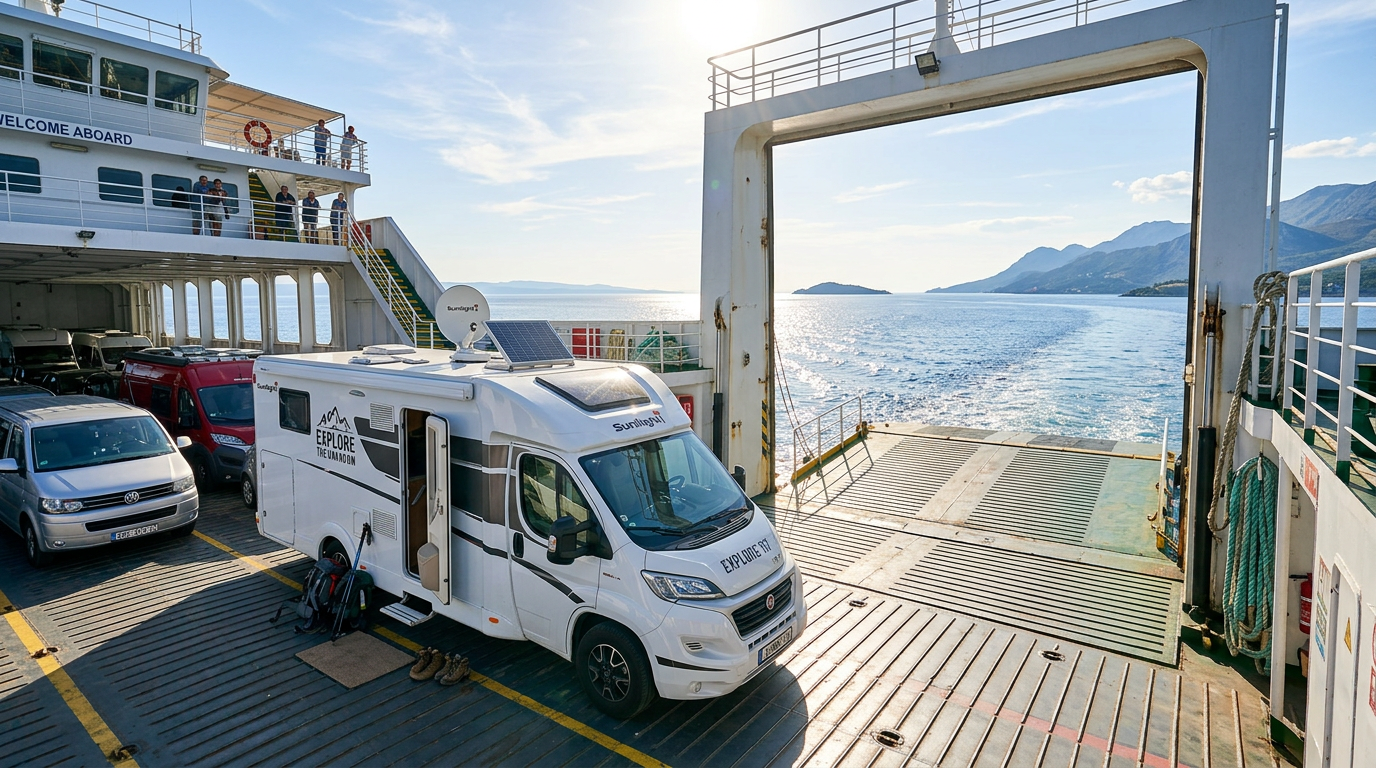
Deciding on a ferry with motorhome P&O vs Brittany Ferries primarily depends on your destination and preferred travel style, with P&O dominating short sea routes and Brittany Ferries offering longer, cruise-style crossings. The choice boils down to whether you prioritise a short sea journey and a longer drive, or a lengthier, more relaxing sea voyage that positions you deeper into France or Spain.
This guide breaks down the key differences to help you make the best decision for your European motorhome adventure.
Key takeaways
- P&O Ferries is ideal for short, frequent, and often cheaper crossings, primarily on the Dover-Calais route.
- Brittany Ferries specialises in longer, more comfortable ‘cruise-ferry’ experiences to western France and Spain from UK south coast ports.
- Your choice depends on your final destination, budget, and whether you prefer a shorter crossing or a shorter drive in Europe.
- Always declare your motorhome’s exact dimensions (length and height) when booking to ensure you are allocated the correct space.
- Both operators offer pet travel schemes, but policies on access and pet accommodation vary significantly by ship and route.
At a Glance: P&O vs Brittany Ferries for Motorhomes
P&O Ferries is geared towards high-frequency, shorter crossings, while Brittany Ferries focuses on longer routes with a more extensive onboard service offering. P&O acts as a high-speed, efficient “sea motorway” to the continent, whereas Brittany Ferries provides a service that is part of the holiday itself.
For motorhome owners, the best choice depends entirely on your priorities: saving time on the water or saving driving time on land. Here’s a simple breakdown of how the two operators compare.
| Feature | P&O Ferries | Brittany Ferries |
|---|---|---|
| Primary Routes | Dover – Calais, Hull – Rotterdam | Portsmouth/Poole/Plymouth – France/Spain |
| Crossing Type | Short Sea (e.g., ~90 mins) | Long Sea / Cruise-Ferry (4-24+ hours) |
| Onboard Focus | Functional, speed, and efficiency | Comfort, dining, entertainment, cabins |
| Price Point | £ – ££ | ££ – ££££ |
| Best For | Quickest sea route to Calais/Benelux | Reaching Western France/Spain, a relaxed start to the holiday |
Routes and Destinations: Where Do You Want to Go?
Your primary destination in Europe is the single biggest factor when choosing between P&O and Brittany Ferries. P&O Ferries is the operator of choice for the fastest and most frequent route between the UK and France, while Brittany Ferries serves a wider range of destinations in western France and northern Spain.
P&O Ferries Routes
P&O is synonymous with the Dover to Calais crossing. With dozens of sailings a day and a journey time of around 90 minutes, it’s the fastest and most flexible way to get a motorhome across the English Channel. This route is perfect if your destination is in Belgium, the Netherlands, Germany, or eastern and southern France, as it provides a quick transfer to the European motorway network. They also operate a key route from Hull to Rotterdam in the Netherlands, which is an excellent overnight option for those starting in the north of the UK.
Many motorhome owners find that taking a motorhome on the Dover to Calais route offers the most flexibility for onward travel.
Brittany Ferries Routes
Brittany Ferries, on the other hand, operates from more westerly UK ports like Portsmouth, Poole, and Plymouth. Their routes are designed to take you deeper into France, bypassing the busy Calais region and saving you a significant amount of driving. Destinations include Caen, St Malo, Cherbourg, and Le Havre.
Crucially, Brittany Ferries is the main operator for motorhome routes to Spain, with long-haul crossings from Portsmouth and Plymouth to Santander and Bilbao. These are overnight or two-night journeys that effectively act as a mini-cruise, saving you the two-day drive through France.
The Onboard Experience: Comfort vs. Speed
The onboard experience with Brittany Ferries is generally more comprehensive than with P&O, reflecting the different crossing durations. For the 90-minute Dover-Calais trip, the needs of a motorhome driver are very different from someone on a 24-hour crossing to Spain.
On a P&O ferry on the short-sea route, the service is efficient and functional. You’ll find self-service restaurants, cafes, a bar, a Club Lounge for an extra fee, and duty-free shops. The goal is to provide a comfortable but brief respite before you continue your journey.
Brittany Ferries ships are in a different class, often described as “cruise-ferries.” On their longer routes, you can expect a much wider range of facilities. These include à la carte restaurants, cinemas, live entertainment, swimming pools (on some vessels), and a far greater variety of cabin accommodations, from simple inside rooms to luxurious suites. The journey becomes an integral and relaxing part of your holiday.
Pricing and Booking Your Motorhome: What to Expect
Pricing for a ferry with a motorhome on both P&O and Brittany Ferries is dynamic and depends on several key factors. It is almost always cheaper to book as far in advance as possible, especially for peak summer dates. The comparison of a ferry with motorhome P&O vs Brittany Ferries often sees P&O as the more budget-friendly option, but this is a reflection of the shorter route.
When booking, you will need to provide the exact dimensions of your motorhome. This includes not just the manufacturer’s standard length, but also any additions like bike racks or tow bars. You must also declare the full height, including any satellite dishes or roof-mounted storage boxes. Providing inaccurate dimensions can lead to being denied boarding or having to pay a significant surcharge at the port.
Travelling with Pets in Your Motorhome
Both P&O Ferries and Brittany Ferries provide options for travelling with pets, but their policies differ significantly. For many, this is a deciding factor in the ferry with motorhome P&O vs Brittany Ferries debate.
On the Dover-Calais route, P&O Ferries offers a “Pet Lounge” where you can travel alongside your dog. This is a significant enhancement on the previous policy where pets had to remain in the vehicle. It must be pre-booked and spaces are limited.
Brittany Ferries leads the way in this area, having offered pet-friendly travel for many years. Depending on the route and ship, options include pet-friendly cabins (where your pet stays with you), pre-bookable kennels of various sizes, or, on some shorter daytime sailings, the option for your pet to remain in the familiar surroundings of your motorhome. You can find more information in this dedicated cross channel ferry with pets guide.
Vehicle Size and Onboard Practicalities
Both operators are well-equipped to handle large motorhomes, but you must declare the correct dimensions at booking to be placed correctly on the vehicle deck. Motorhomes, especially those over a certain height (usually around 2.4 metres), are directed into specific lanes and boarded alongside lorries and other high-sided vehicles on decks with more headroom.
It is a universal safety regulation that you cannot stay in your motorhome or access the vehicle decks during the crossing. Once you have parked as directed by the crew, you must make your way to the passenger lounges for the duration of the journey.
Conclusion: Which Ferry Operator Should You Choose?
Ultimately, the best choice in the ferry with motorhome P&O vs Brittany Ferries debate rests on your holiday plans. Neither operator is definitively “better”; they simply serve different purposes.
If your plan is to explore Northern or Eastern Europe, or you want the quickest, most frequent, and often cheapest crossing to France before embarking on a long drive, P&O Ferries via the Dover to Calais route is your logical choice. It’s an efficient-get-you-there service.
If your destination is in Normandy, Brittany, the west coast of France, or Spain and Portugal, Brittany Ferries is almost certainly the better option. The longer, more expensive crossing buys you a more relaxed start to your holiday and saves you hundreds of miles of driving, fuel, and potential overnight stays on the continent. The choice between a shorter sea crossing or a shorter drive is the central question for anyone planning a European motorhome trip.
Related reading
- Harwich to Hook of Holland vs Flying to Amsterdam: Which?
- Find Cheap Aberdeen Kirkwall Ferry Tickets: A Guide
Frequently Asked Questions
Which is cheaper for a motorhome, P&O or Brittany Ferries?
Generally, P&O Ferries on the Dover-Calais route is cheaper than Brittany Ferries’ longer routes. However, prices are dynamic, so the actual cost depends on the route, time of booking, season, and your vehicle’s specific dimensions. Always compare prices for your specific dates.
Can you stay in your motorhome on a ferry?
No, it is strictly forbidden for safety reasons. All passengers and pets must leave the vehicle deck and move to the passenger areas for the duration of the crossing. Car decks are sealed off once the ferry departs.
Which ferry company is best for Spain with a motorhome?
Brittany Ferries is the primary operator for direct ferry routes from the UK to Spain. They offer long-haul, comfortable crossings from Portsmouth and Plymouth to Santander and Bilbao, which is ideal for motorhome travellers heading to Spain or Portugal.
Do I need to book a cabin for a motorhome ferry crossing?
Cabins are optional for short daytime crossings like Dover to Calais. However, for overnight or multi-day journeys, such as those to Spain with Brittany Ferries, booking a cabin is highly recommended for comfort and is often mandatory as part of the ticket.
What happens if my motorhome is bigger than I booked?
If your motorhome is larger than the dimensions you declared during booking, you may be charged an excess fee at the port. In worst-case scenarios, if the ferry is full or cannot accommodate your actual size, you could be denied boarding.
Does a bike rack count towards my motorhome length on a ferry?
Yes. You must declare the total overall length of your vehicle, including any fixtures like bike racks or tow bars. This is crucial for ensuring you are allocated a space on the car deck that is physically long enough.